
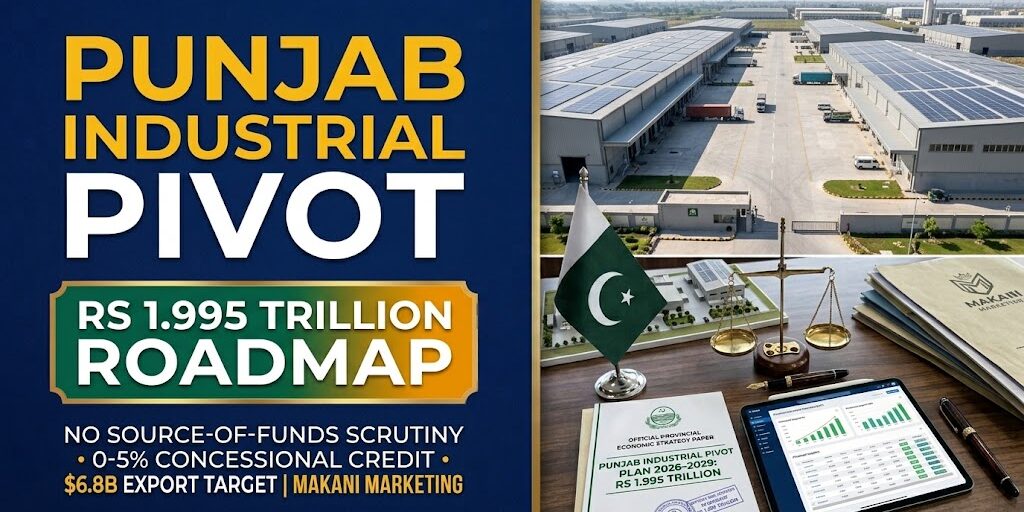
In a decisive move to catalyze domestic capital formation and attract large-scale industrial relocation, Punjab Chief Minister Maryam Nawaz Sharif has officially unveiled the landmark Rs 1.995 Trillion PIVOT Plan (Punjab Innovation for Value, Opportunity and Transformation 2026–2029) in Lahore.
Addressing a high-level assembly of international diplomats, corporate titans, and institutional financiers—including Nishat Group Chairman Mian Muhammad Mansha, Arif Habib, Fatima Group’s Fawad Mukhtar, Gul Ahmed’s Ziad Bashir, and Ferozsons Laboratories’ Osman Khalid Waheed—the Chief Minister delivered an unequivocal pitch to prospective manufacturers: the Punjab Government will not question the origin or source of capital for industrialists who establish operational manufacturing plants, corporate enterprises, and industrial facilities within the province.
The three-year economic roadmap is engineered to dismantle regulatory red tape, transition the provincial economy from agrarian dependence into an export-led industrial powerhouse, and unlock billions in private equity. By targeting $6.8 billion in incremental exports, 162,000 high-value direct jobs, and sustainable livelihoods for over 1 million households, the PIVOT Plan represents the largest unified provincial industrial initiative in Pakistan’s economic history.
                 [The Rs 1.995 Trillion PIVOT Strategic Architecture]
                                          │
        ┌─────────────────────────────────┼─────────────────────────────────┐
        ▼                                 ▼                                 ▼
[Financing & Modernization]        [Targeted Economic Outcomes]      [Business Deregulation]
• Rs 1.089T Public-Sector Capital  • $6.8 Billion Additional Exports • Zero Source-of-Funds Audit
• Rs 906 Billion Private Equity    • 162,000 Direct Jobs Created     • 300 Public Services Digitized
• Rs 300B Concessional Loans (0–5%)• 4 Agro-Industrial Parks Built   • E-Biz One-Window Automation
• Rs 753.7B Industrial Production  • Over 1 Million Livelihoods Aided• Zero Red-Tape Bureaucracy
1. Capital Mobilization: Public-Private Co-Investment Framework
The PIVOT Plan’s financial framework is structured around shared fiscal commitments between the state and private enterprise:
- Blended Capital Structure: The initiative combines Rs 1,089 billion in provincial public-sector infrastructure allocations with a targeted Rs 906 billion in direct private-sector corporate investments.
- Rs 300 Billion Concessional Financing: To counteract elevated commercial benchmark interest rates, the Punjab Government has earmarked Rs 300 billion in subsidised industrial credit, carrying interest rates ranging from 0% to a maximum of 5%. This credit facility is tailored specifically for plant modernization, technology adoption, and greenfield manufacturing setups.
- Industrial Sector Allocations: A dedicated Rs 753.7 billion is reserved exclusively for industrial production, value addition, and export competitiveness across garments, leather goods, footwear, sports equipment, surgical cutlery, and electric fan manufacturing clusters.
- Clean Energy & Battery Storage Subsidies: Recognizing industrial energy tariffs as a primary manufacturing bottleneck, Rs 50 billion has been allocated for commercial solar arrays and Battery Energy Storage Systems (BESS), alongside duty-free import exemptions for advanced capital machinery.
2. The Policy Pivot: Removing Scrutiny to Unlock Industrial Land Capital
The pledge to refrain from questioning the source of investment funds marks an administrative shift intended to channel informal, dormant liquidity into documented physical infrastructure and industrial expansion.
By removing regulatory hurdles and bureaucratic bottlenecks, the provincial administration is creating an environment where corporate leaders and overseas Pakistani business groups can acquire industrial land, erect logistics hubs, and construct factories without harassment from administrative inspectorates.
To institutionalize this ease-of-doing-business doctrine, the government launched the STEP Portal (Strategic Trade Enhancement Programme) and is digitizing 300 municipal and business services via the E-Biz platform. These platforms consolidate corporate registration, environmental approvals, utility connections, and building sanctions into a single-window digital process.
                 [Capital Deployment: Liquid Wealth to Industrial Assets]
                                            │
                                            ▼
               [Investor Mobilizes Liquid Capital / Undisclosed Reserves]
                                            │
                                            ▼
               [Exempted from Provincial Source-of-Funds Interrogation]
                                            │
        ┌───────────────────────────────────┴───────────────────────────────────┐
        ▼                                                                       ▼
[Industrial Real Estate Allocation]                           [Manufacturing Infrastructure]
• Special Economic Zones (SEZs) & Industrial Parks            • Construction of modern production units
• Ready-to-use industrial plots & warehouse yards             • Import of duty-free machinery & solar setups
• Logistics hubs along M-2, M-3, and M-11 Corridors           • Access to 0–5% concessional credit lines
• Long-term physical asset capital appreciation               • Generation of dollar-denominated export cash flows
3. Real Estate & Infrastructure Synergies: The Industrial Property Surge
For commercial real estate developers, industrial zone operators, and corporate asset managers, the PIVOT Plan represents a catalyst for land valuations across Punjab’s primary transit corridors:
- Agro-Processing & Cold-Chain Parks: The establishment of four dedicated agro-processing parks in Sahiwal, Khushab, and key agricultural nodes will drive institutional demand for specialized industrial land parcels, integrated warehousing, and temperature-controlled storage facilities.
- Industrial Corridor Expansion: Commercial acreage adjacent to the M-2 (Lahore-Islamabad), M-3 (Lahore-Abdul Hakeem/Faisalabad), and M-11 (Lahore-Sialkot) motorways is positioned for sustained appreciation as light manufacturing, textile processing, and electric vehicle supply chains seek shovel-ready ground.
- Special Economic Zones (SEZs) Transformation: The combination of zero question on fund origins, 0–5% financing, and subsidized solar installations provides the ideal environment for corporate REITs, private equity consortiums, and real estate funds to construct built-to-suit industrial facilities for multinational and domestic tenants.
4. Macroeconomic Outlook & Execution Safeguards
To ensure that PIVOT does not languish as an aspirational white paper, the administration has instituted a central PIVOT Dashboard and an Industry Scorecard. Operational milestones will be monitored directly by Chief Secretary Zahid Akhtar Zaman and provincial cabinet desks, with the operational mechanisms mandated to achieve full field execution within six months.
For domestic family offices, real estate syndicates, and overseas Pakistani investors, this historic deregulation signals an opportune moment to redeploy capital into Punjab’s physical economy. Transforming liquid capital into certified industrial land, export-grade manufacturing plants, and integrated commercial logistics hubs remains the premier strategy for building long-term, inflation-hedged corporate wealth.
At Makani Marketing, our corporate real estate and industrial advisory desk assists investors in navigating Special Economic Zones, acquiring verified commercial land parcels, and structuring compliant industrial developments across Pakistan’s fastest-growing economic corridors.