
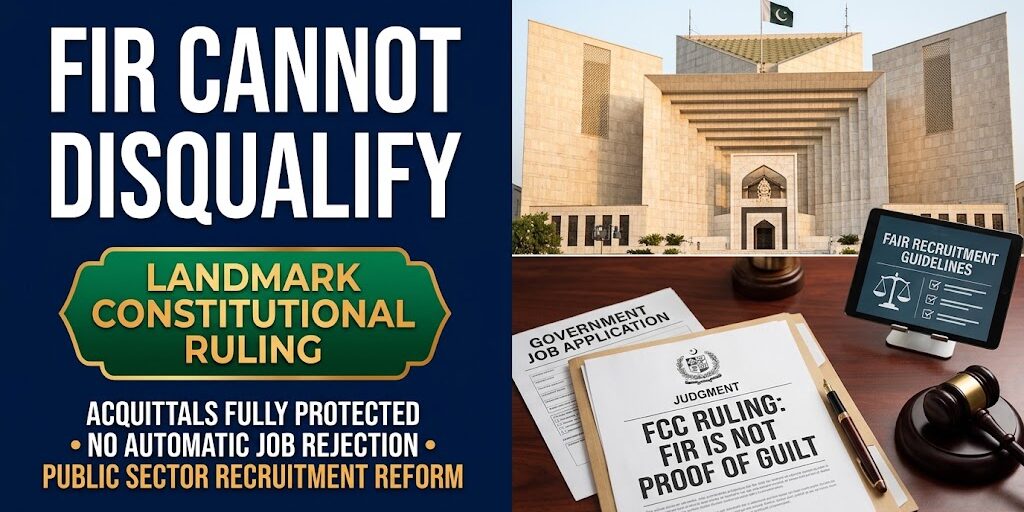
In a landmark constitutional ruling providing extensive relief to job aspirants across Pakistan, the Federal Constitutional Court (FCC) has officially established that the mere registration of a First Information Report (FIR) cannot serve as an automatic or perpetual ground to disqualify an individual from public sector employment.
The ruling explicitly draws a sharp line between an accusatory instrument and judicially established culpability, emphasizing that an FIR is merely an initial allegation and does not constitute proof of guilt. The judgment sets aside conflicting high court decisions and lays down binding principles for criminal background checks during government recruitment.
                 [Federal Constitutional Court Criminal Background Guidelines]
                                             │
        ┌────────────────────────────────────┼────────────────────────────────────┐
        ▼                                    ▼                                    ▼
[The Core Legal Rule]                 [Recognition of Acquittals]          [Procedural Fairness]
• FIR does not equal proof of guilt   • Judicial acquittals must be respected• Mandatory right to a hearing
• No automatic disqualification       • Suspicion cannot override verdicts  • Objective, verifiable evidence required
• Prevents indefinite career stigma    • Clear police character certificates• Transparent merit-based alignment
1. The Six Guiding Principles for Public Sector Recruitment
To eliminate bureaucratic discrimination and establish uniform, constitutionally compliant standards across all federal and provincial departments, the Federal Constitutional Court outlined six definitive principles for antecedent verification:
- No Automatic Disqualification via FIR: The registration of an FIR shall not ipso facto disqualify a candidate from public service, as an unproven criminal allegation cannot be used as an indelible career stigma.
- Full Recognition of Judicial Acquittals: Once a court of law acquits a candidate, administrative bodies must respect the verdict and cannot penalize the individual based on lingering suspicion.
- Protection in Police Character Certificates: Historical cases that resulted in a judicial acquittal cannot be portrayed negatively or used to issue adverse remarks on official police character certificates.
- Strict Status Tracking for Pending Cases: If a criminal case is genuinely still under active trial, recruitment authorities can reference its pending legal status, but cannot treat it as a final conviction.
- Mandatory Right to a Hearing: No candidate can be excluded from public employment without being given a fair, meaningful opportunity to explain their position and receive a reasoned determination.
- Alignment with Merit and Equality: All recruitment screening decisions must strictly comply with statutory criteria, merit, proportionality, and constitutional guarantees of fairness.
2. Reforming Public Administration and Recruitment Policies
The court directed all relevant federal and provincial departments—particularly law-enforcement and civil service selection boards—to review and harmonize their recruitment guidelines with these constitutional standards. The ruling prevents administrative overreach, ensuring that state institutions evaluate job seekers based on transparent credentials, lawful procedures, and absolute respect for judicial findings rather than arbitrary conjecture.