
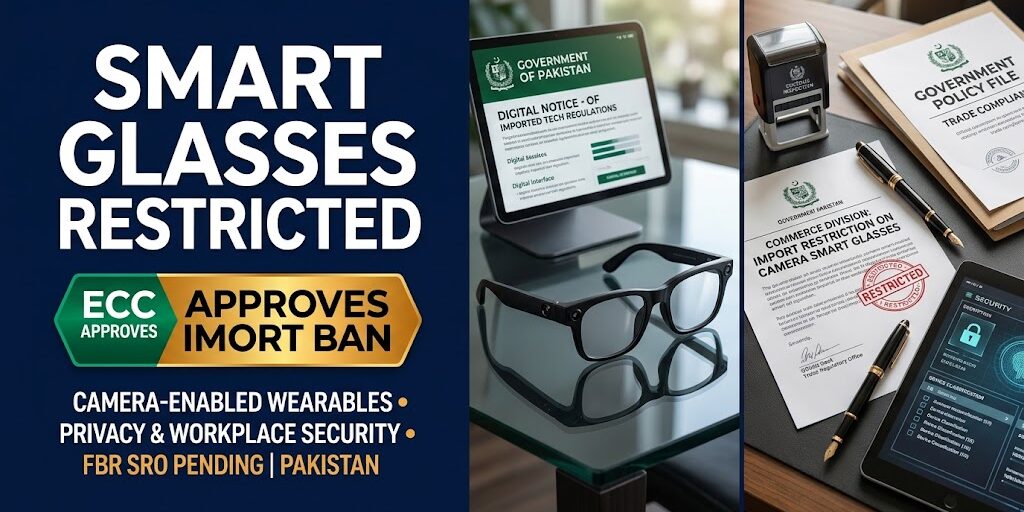
In a major policy decision concerning consumer technology, privacy protection, and commercial compliance, the Economic Coordination Committee (ECC) of the Federal Cabinet—chaired by Finance Minister Senator Muhammad Aurangzeb—has officially approved nationwide restrictions on the import of camera-enabled smart glasses (including popular wearable tech models such as Ray-Ban Meta smart glasses).
The decision follows a summary tabled by the Commerce Division amidst mounting regulatory scrutiny regarding the discreet, continuous recording capabilities of wearable AI and camera glasses. Lawmakers and privacy advocates have raised concerns over unauthorized filming, the compromise of confidential corporate data, and the protection of individual privacy in public spaces and professional workplaces.
                 [ECC Camera-Enabled Smart Glasses Regulatory Framework]
                                            │
        ┌───────────────────────────────────┴───────────────────────────────────┐
        ▼                                                                       ▼
[The Core Import Restriction]                  [Provincial Workplace Directives]
• Approved via ECC (Commerce Division summary) • Recommended rules for provincial governments & ICT
• Targets camera-equipped wearables (Meta, etc.)• Focus on unauthorized recording in offices & public spaces
• Awaiting formal SRO notification by FBR      • Addressing data privacy and surveillance risks
1. Rationale Behind the Import Curb
While wearable technology featuring integrated cameras and voice assistants has gained immense global popularity, local regulatory authorities have flagged several vulnerabilities:
- Unmonitored Surveillance & Privacy Infractions: The ability of smart glasses to capture high-definition video and audio discreetly without visible cues (such as traditional camera shutter clicks) presents severe challenges to personal privacy.
- Workplace and Corporate Security Risks: Unauthorized recordings in corporate offices, financial institutions, and government installations pose risks to intellectual property and national security.
- Provincial Workplace Regulations: Alongside restricting commercial imports at federal customs gates, the ECC has recommended that provincial governments and the Islamabad Capital Territory (ICT) administration formulate targeted workplace regulations governing the active use of such devices.
2. Scope, Enforcement, and Legal Next Steps
As consumers and gray-market tech traders assess the policy announcement, several operational aspects remain subject to formal administrative execution:
- Formal SRO Issuance: The ECC’s decision serves as a policy endorsement. For the restriction to take full legal effect at international entry ports, the Federal Board of Revenue (FBR) must issue a formal Statutory Regulatory Order (SRO) amending import schedules.
- Status of Existing Devices: The policy directive targets commercial imports; it does not explicitly entail the confiscation of personal devices already owned or operated by individuals within the country.
- Interim Provincial Measures: Certain regional authorities (such as provisional local orders in Punjab) have already implemented temporary operational restrictions on wearing or operating camera-equipped glasses in specific public domains, signalling a synchronized federal-provincial push toward stricter surveillance governance