
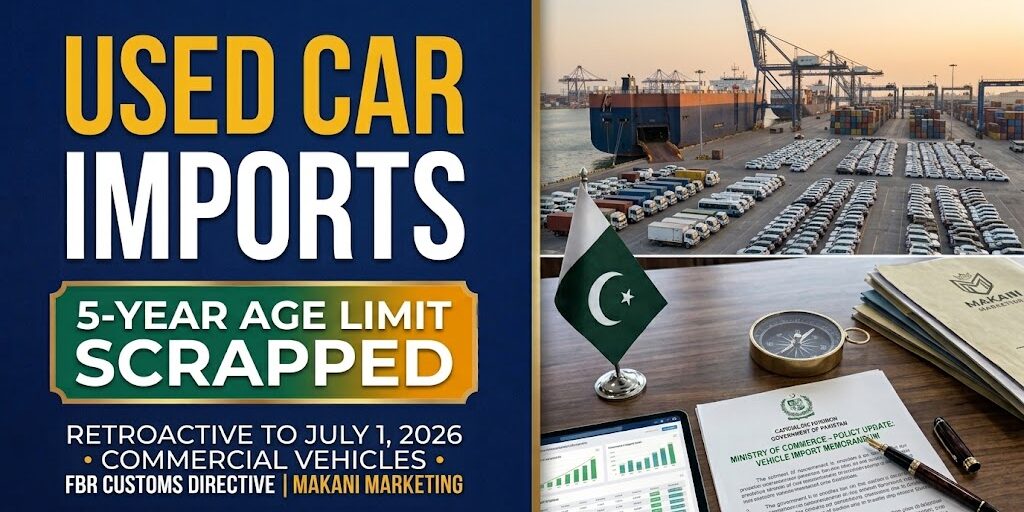
In a regulatory breakthrough reshaping Pakistan’s automotive trade landscape, the Ministry of Commerce has officially confirmed the total removal of the five-year age limit on commercial imports of used vehicles, applying the decision retrospectively from July 1, 2026.
Conveyed to the Federal Board of Revenue (FBR) via an official Office Memorandum (Reference No. 1(14)/2025-IMP-III-0010) dated October 30, 2026, the clarification resolves months of operational ambiguity at major dry ports and maritime container terminals. In response to the FBR’s formal inquiry submitted on October 23, the Commerce Ministry clarified that following the approved decision of the Federal Cabinet, the statutory five-year age cap on commercial automotive consignments ceased to apply after June 30, 2026.
This policy change marks a transition in Pakistan’s automotive trade policy, giving commercial importers, automotive trade syndicates, and transport fleet operators direct access to a broader international inventory across global auction hubs.
              [Pakistan Commercial Used Vehicle Import Architecture]
                                         │
        ┌────────────────────────────────┼────────────────────────────────┐
        ▼                                ▼                                ▼
[The Regulatory Shift]           [Covered Tariff Classifications]  [Statutory Compliance Rails]
• 5-year age limit abolished     • PCT 8702: Public transport buses• Duties & custom valuations apply
• Effective date: 1 July 2026    • PCT 8703: Passenger motor cars  • Phased 40% regulatory duty scale
• Formally notified: Oct 30, 2026• PCT 8704: Goods transport trucks• Mandatory quality & safety tests
• FBR customs clearance unblocked• PCT 8705: Special-purpose units• Clean auction record verification
1. Statutory Scope: The Four Covered Pakistan Customs Tariff (PCT) Headings
The Commerce Ministry’s circular applies beyond standard private passenger vehicles. The lifting of the age ceiling spans four primary Pakistan Customs Tariff (PCT) chapters:
- PCT Heading 8702: Commercial transport vehicles designed to transport ten or more passengers, including intercity mass-transit coaches, luxury tour buses, and municipal transit fleets.
- PCT Heading 8703: Passenger cars, motor cars, and specialized sports utility vehicles (SUVs), including sedans, hatchbacks, hybrid electric vehicles (HEVs), and battery electric vehicles (EVs).
- PCT Heading 8704: Commercial goods-transport motor vehicles, such as light-duty delivery trucks, heavy-duty prime movers, flatbeds, and distribution carriers.
- PCT Heading 8705: Special-purpose motor vehicles, including mobile cranes, concrete mixer trucks, fire-fighting tenders, hydraulic platform vehicles, and industrial breakdown lorries.
By extending the waiver across industrial, logistical, and mass-transit categories, the government aims to modernize commercial fleet capabilities, lower logistics costs for industrial freight, and expand capacity across corporate transport networks.
2. Commercial Imports vs. Personal Baggage & Gift Schemes
To avoid customs disputes, automotive trade desks and corporate fleet buyers must distinguish between the commercial import route and traditional expatriate schemes:
             [Comparative Matrix: Commercial Channel vs. Expatriate Schemes]
                                            │
        ┌───────────────────────────────────┴───────────────────────────────────┐
        ▼                                                                       ▼
[Commercial Import Track (October 2026 Update)]               [Personal Baggage / Transfer of Residence / Gift]
• Open to registered domestic commercial corporate entities   • Restricted to overseas Pakistani passport holders
• 5-Year age limit scrapped retroactively (July 1, 2026)      • Strictly governed by standard Import Policy Order
• Operates under commercial Letters of Credit / open accounts • Mandatory foreign remittance proof from overseas bank
• Governed by SRO 1895(I)/2025 compliance & inspection        • 3-Year age cap for cars; 5-year cap for 4x4 SUVs
• Transparent commercial accounting on domestic balance sheets• Personal utilization focus; non-commercial registration
While individual passenger schemes—such as Personal Baggage, Transfer of Residence (TR), and the Gift Scheme—remain subject to strict procedural documentation (including bank encashment certificates and foreign remittance proofs), the commercial import stream allows registered Pakistani trading corporations to import vehicles directly for resale, logistics use, and enterprise leasing.
Use up and down arrow keys to resize the meta box pane.
3. Tariff Protection, Duties, and Import Realities
The abolition of the age restriction expands import options, but it does not represent an unvetted or duty-free framework:
- The Phased Regulatory Duty Structure: The commercial opening of used vehicle imports operates under a phased tariff protection mechanism. This framework includes an additional 40 percent regulatory duty, designed to taper down by 10 percentage points annually through 2029–30 to balance competitive access with domestic automotive manufacturing protections.
- Prescribed Environmental & Quality Audits: Under statutory regulatory order SRO 1895(I)/2025, commercially imported vehicles must meet prescribed vehicle emission, roadworthiness, and safety criteria before securing customs clearance. Older stock must undergo certified pre-shipment inspections and physical clearance verification at Pakistani entry ports.
- Surging Port Inflows: The phased policy shifts have already led to higher import volumes. Commercial import volumes recorded a sharp surge—rising from just 48 units in May to 2,276 vehicles in September 2026 alone—signaling strong pent-up market demand for imported vehicle options.
                     [Commercial Import Clearance & Compliance Workflow]
                                             │
                                             ▼
               [Step 1: Vehicle Sourcing & Auction Sheet Forensic Audit]
                 (Verify Odometer Integrity, Chassis History & Grade Sheet)
                                             │
                                             ▼
               [Step 2: Pre-Shipment Inspection & Environmental Clearance]
                (Mandatory SRO 1895(I)/2025 Safety & Roadworthiness Checks)
                                             │
                                             ▼
               [Step 3: Port Arrival & Customs Assessment Filing via WeBOC]
               (FBR Classification under PCT 8702, 8703, 8704, or 8705 Heads)
                                             │
                                             ▼
               [Step 4: Landed Cost Settlement & Final Port Gate-Out]
             (Assessment of Base Duties, Regulatory Levies & Sales Taxes)
4. Macroeconomic Impact on Corporate Fleets and Real Estate Logistics
From a corporate asset management and commercial logistics perspective, the removal of the five-year ceiling delivers immediate operational advantages:
- Logistics and Warehousing Efficiencies: Commercial warehousing, distribution hubs, and industrial logistics parks across the M-2, M-3, and M-5 corridors require cost-effective distribution fleets. Lifting age barriers on light-duty commercial trucks (PCT 8704) allows logistics firms to deploy durable delivery vehicles at reduced acquisition costs.
- Corporate Asset Diversification: Enterprise fleet managers and private mobility operators can acquire reliable hybrid utility vehicles, corporate shuttle vans, and executive transit buses at competitive capital-expenditure price points.
- Balance Sheet Flexibility: Lower capital outlays for commercial utility and transport vehicles free up liquid working capital, allowing domestic enterprises to direct investment into core operational real estate, warehouse acquisitions, and high-yield physical development assets.
At Makani Marketing, our corporate commercial research and asset management desk analyzes trade policies, tariff modifications, and capital-expenditure regulations to help businesses and private investors allocate capital effectively across Pakistan’s commercial real estate and industrial corridors