
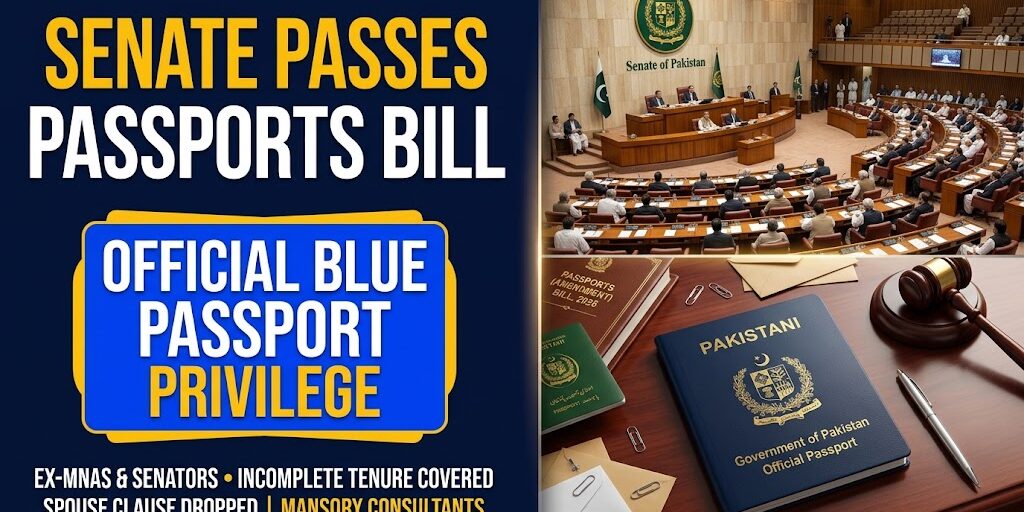
In a notable legislative development reshaping official state protocol and travel privileges, the Senate of Pakistan has passed the Passports (Amendment) Bill, 2026.
The amendment grants former Members of the National Assembly (MNAs) and Senators the legal entitlement to retain and use their gratis official (blue) passports after leaving office, even if they completed only a partial term or left office prior to the full constitutional completion of their parliamentary tenure.
Moved by private members, the bill seeks to address long-standing procedural disparities between the two parliamentary chambers and align former lawmakers’ protocol with senior civil bureaucrats. However, the legislation underwent critical revisions prior to its passage in the Upper House: a contentious proposal that sought to extend official blue passport privileges to the spouses and dependent children (under the age of 28) of former lawmakers was formally withdrawn following scrutiny and government opposition.
The bill has now been formally transmitted to the National Assembly for debate and final enactment.
At Mansory Consultants, our corporate mobility, consular visa, and travel documentation advisory desk tracks cross-border travel regulations, state documentation protocols, and international border clearance standards. Below is the full legislative analysis, the operational distinction between travel document categories, and the broader international context surrounding official passports.
Passports (Amendment) Bill, 2026 at a Glance
| Legislative Parameter | Statutory Specification |
| Enacting Body | Senate of Pakistan (Upper House) |
| Legislative Measure | The Passports (Amendment) Bill, 2026 |
| Primary Beneficiaries | Retired / Former MNAs and Senators |
| Core Revision | Eliminates mandatory full-tenure service condition for retention |
| Document Classification | Official (Blue) Passport (Gratis) |
| Family Extension Status | Formally Withdrawn (Spouses & children under 28 excluded) |
| Next Legislative Stage | Referred to the National Assembly for passage |
| Regulatory Administrator | Directorate General of Immigration & Passports (DGI&P) |
| Advisory & Compliance | Mansory Consultants Global Mobility Desk |
1. Disparity Removal: Full Tenure vs. Partial Service
Under previous guidelines laid down in the Passport Rules, 2021, parliamentarians faced conflicting eligibility thresholds depending on which house of parliament they represented:
[PREVIOUS REGIME (Passport Rules, 2021)]
• MNAs: Eligible for blue passport upon oath; retained under varying tenure rules.
• Senators: Required to complete a full 6-year constitutional term to retain after retirement.
• Incomplete Terms: Lawmakers exiting due to assemblies dissolving early lost eligibility.
                                     │
                                     ▼
[REVISED FRAMEWORK (Passports Amendment Bill, 2026)]
• Establishes statutory parity across both Houses (National Assembly & Senate).
• Any member taking the constitutional oath—for a full term or remainder of a term—retains the passport.
• Dissolution of assemblies or early resignations will no longer revoke post-office retention.
The statement of objects and reasons for the amendment articulates that the reform brings parity with the privileges accorded to retired high-ranking civil bureaucrats, ensuring uniform recognition of state service at the federal legislative level.
2. The Dropped Family Extension & International Scrutiny
The legislative debate on the Senate floor highlighted the sensitive intersection between domestic parliamentary privileges and international border security.
- Withdrawal of the Family Clause: A separate companion amendment to Section 12 of the Members of Parliament (Salaries and Allowances) Act, 1974—which aimed to extend blue passports to lawmakers’ spouses and dependent unmarried children under 28 years of age—was formally opposed by the Ministry of Interior and withdrawn by the mover.
- Downsizing the Blue Passport Footprint: The government revealed during debate that the federal administration had actively reduced the total circulation of official blue passports nationwide from approximately 75,000 down to 45,000.
- International Border Scrutiny: This reduction followed diplomatic concerns raised by foreign governments—including several European Schengen destinations and Canada—over the wide proliferation of official-category travel documents presented by non-diplomatic individuals, family dependents, and non-state delegates.
3. Understanding Pakistan’s Passport Hierarchy
Pakistan’s Directorate General of Immigration and Passports (DGI&P) issues three primary categories of travel booklets, each carrying distinct legal mandates and privileges:
| Passport Category | Cover Color | Authorized Issuance Pool | Permissible Travel Purpose |
| Ordinary Passport | Green | All general citizens of Pakistan | Private tourism, business, study & international employment |
| Official Passport | Blue | Parliamentarians, judicial officers, civil servants & state executives | Official state delegations, government duties & authorized post-retirement privilege |
| Diplomatic Passport | Red | Foreign service officers, cabinet ministers, heads of state & top constitutional offices | Sovereign bilateral missions, diplomatic postings & international statecraft |
4. Key Travel Realities: Does a Blue Passport Guarantee Visa-Free Travel?
A common misconception among travelers is that holding an official blue passport grants universal visa-free entry. In practice, international consular law governs its use strictly:
- Bilateral Visa Abolition Accords: Blue passports grant visa-free entry or visa-on-arrival privileges only to countries with which Pakistan has signed reciprocal bilateral visa-waiver agreements for official/service passports (primarily select partner states in Asia, the Middle East, and South America).
- Western & Schengen Restrictions: For major Western jurisdictions—including the United States, the United Kingdom, Canada, Australia, and the Schengen Area—an official blue passport does not bypass visa scrutiny. Holders traveling on non-official, personal, or private business trips must still apply for formal entry visas, submit verifiable documentation, and demonstrate personal solvency.
- No-Objection Certificate (NOC) Protocols: Serving civil servants and government officials using blue passports must secure formal departmental clearance (NOCs) to prevent unrecorded foreign travel and ensure compliance with airport departure checks.
Ensure Compliant Overseas Mobility with Mansory Consultants
Whether traveling for business, education, or professional relocation, navigating international consular standards requires strictly compliant documentation, genuine visas, and transparent declarations across all passport categories.
At Mansory Consultants, our international travel, higher education, and corporate mobility desk provides:
- Comprehensive eligibility assessments and documentation review for European Schengen visas, the UK, the US, Canada, and the Far East.
- Verification of business itineraries, corporate sponsorships, and conference invitations.
- Complete educational and civil document legalizations through HEC, IBCC, and the Ministry of Foreign Affairs (MOFA) with digital QR-code attestations.
- Professional departure compliance checks ensuring complete alignment with Pakistan’s immigration statutes and airport border controls.
Contact Mansory Consultants today for transparent, verified, and legally sound visa and global mobility advisory.