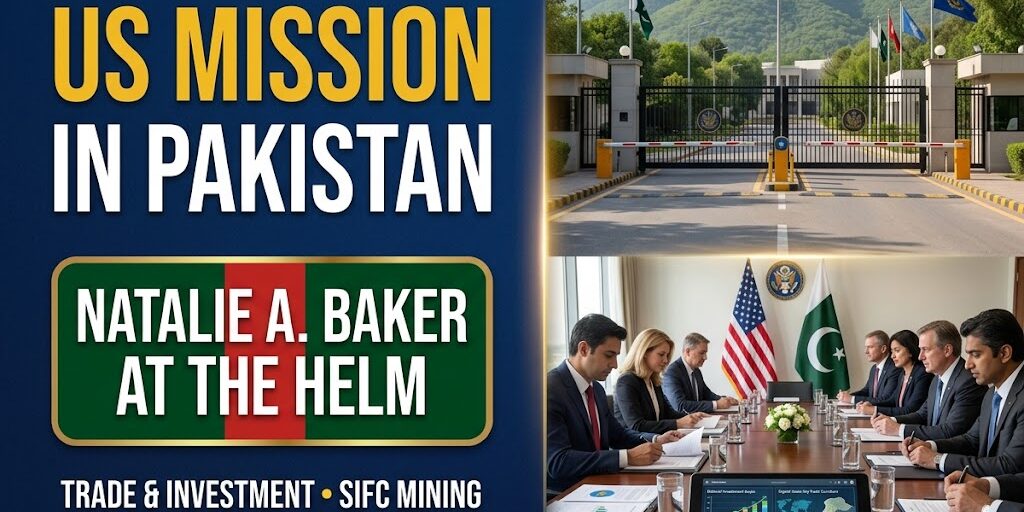
In a pivotal leadership transition at the American diplomatic mission in Islamabad, Senior Foreign Service career diplomat Natalie A. Baker has officially assumed duties as the Chargé d’Affaires of the United States Mission to Pakistan.
Having previously arrived in Islamabad as Deputy Chief of Mission in August 2024 and stepped up to lead mission operations, Minister Counselor Baker brings extensive experience from senior diplomatic assignments across Doha, Libya, Kuwait, and the broader Middle East. Her continuity in leadership anchors Washington’s diplomatic and economic engagement with Pakistan, steering bilateral cooperation beyond traditional security coordination into expanded commerce, private-sector investment, artificial intelligence and emerging technologies, renewable energy transition, and critical mineral development.
At Makani Marketing, our real estate, industrial infrastructure, and macroeconomic advisory desk tracks international diplomatic alignments. Sovereign bilateral stability and foreign direct investment (FDI) inflows are primary drivers of currency stabilization, corporate infrastructure expansion, and prime commercial real estate valuation across Islamabad and national logistics corridors. Below is an analytical review of this diplomatic leadership milestone, bilateral economic priorities, and downstream property impacts.
US Mission Leadership & Bilateral Portfolio at a Glance
| Strategic Parameter | Official Diplomatic & Economic Specification |
| Diplomatic Envoy | Natalie A. Baker (Minister Counselor, Senior Foreign Service) |
| Current Office | Chargé d’Affaires, U.S. Mission to Pakistan |
| Diplomatic Base | U.S. Embassy, Diplomatic Enclave, Sector G-5, Islamabad |
| Educational Credentials | BA (Princeton University), MPP (Harvard University), National War College |
| Core Economic Agendas | Bilateral Trade, Critical Minerals (SIFC), AI & Tech, Clean Energy |
| Institutional Conduit | U.S.-Pakistan Green Alliance Framework & Trade/Investment Dialogue |
| Real Estate Impact | Class-A office absorption, corporate guest corridors, and transit hubs |
| Strategic Advisory Desk | Makani Marketing Macroeconomic & Commercial Advisory |
1. Diplomatic Profile: Seasoned Leadership for Complex Ties
Natalie A. Baker’s assumption of mission leadership ensures seasoned, continuous management of the diplomatic pipeline:
[Natalie A. Baker: Distinguished Career FSO & Regional Specialist]
                                │
    ┌───────────────────────────┼───────────────────────────┐
    ▼                           ▼                           ▼
[Deputy Chief & Chargé]    [Deputy Chief of Mission]   [Deputy Director]
U.S. Mission to Libya       U.S. Embassy Doha, Qatar   Iran Regional Presence Office
                                │                      (U.S. Consulate Dubai)
                                ▼
         [August 2024: Deputy Chief of Mission, Islamabad]
                                │
                                ▼
         [January 2025 – Present: Chargé d'Affaires, U.S. Mission Pakistan]
Baker’s prior background as Economic Counsellor in Kuwait and Deputy Chief of Mission in Doha provides her with specialized insight into energy logistics, Gulf-South Asia capital flows, and sovereign investment structures. Her mission leadership aligns with Washington’s strategy to engage Pakistan through commercial, technological, and climate-resilience partnerships.
2. Key Pillars of US–Pakistan Economic Engagement
The contemporary US–Pakistan bilateral relationship has pivoted toward high-value economic sectors:
- Trade Expansion & Market Access: The United States remains Pakistan’s largest single-country export destination, absorbing billions in textiles, surgical equipment, IT services, and agro-commodities. Stabilizing trade channels underpins national foreign exchange reserves.
- Critical Minerals & Energy Diplomacy: Following Pakistan’s official invitation to American mining majors through the Special Investment Facilitation Council (SIFC), US institutional financing (including US EXIM Bank instruments) is being explored for copper-gold corridors across Balochistan’s Chagai and Tethyan belts.
- U.S.-Pakistan Green Alliance: Joint bilateral investments in climate-smart agriculture, water desalination, hydropower efficiency, and grid modernization designed to build long-term climate resilience.
- Artificial Intelligence & Digital Services: Facilitating American venture linkages with Pakistani IT talent, offshore development agencies, and fintech startups operating out of Islamabad, Lahore, and Karachi.
3. Macroeconomic Ripple Effect on Pakistan’s Real Estate Market
International diplomatic transitions directly influence private sector sentiment, foreign remittances, and commercial real estate demand:
[Strengthened Bilateral Ties & Economic Dialogue (US–Pakistan)]
                               │
                               ▼
[Increased Institutional Inflows, Trade Surpluses & Currency Stability]
                               │
                               ▼
[Confidence in Large-Scale Infrastructure & Industrial Corridors]
                               │
        ┌──────────────────────┴──────────────────────┐
        ▼                                             ▼
[Corporate Real Estate Uptick]              [Industrial & Logistics Land]
• Class-A commercial towers absorb MNCs    • Warehousing hubs expand along motorways
• Demand spikes in Islamabad G-5, Blue     • Dry-port and export processing zones
  Area & New Blue Area corridors              gain commercial valuation momentum
- Corporate Office Absorption in Islamabad: As bilateral trade initiatives, multinational tech collaborations, and development agencies expand their local presence, demand for high-grade commercial office spaces in Blue Area, New Blue Area (Sector G-9/F-9), and the Diplomatic Enclave (Sector G-5) experiences steady upward yield pressure.
- Expatriate Investor Confidence: Overseas Pakistanis residing in North America contribute heavily to national remittance volumes. Predictable foreign relations and sovereign economic roadmaps incentivize expatriate capital into secure, master-planned residential and commercial assets in the Twin Cities.
- Logistics & Warehousing Expansion: Bilateral industrial supply chains demand expanded transit warehousing and dry-port facilities along the N-5 National Highway, Rawalpindi Ring Road (R3), and the M-1/M-2 motorway arteries.
4. Real Estate Investor Takeaway: Aligning with Sovereign Growth
Commercial real estate value is fundamentally anchored to national economic stability and cross-border commercial velocity:
- Focus on Institutional Corridors: Commercial acquisitions located in sectors serving diplomatic, corporate, and multilateral organizations deliver resilient rental yields and lower tenant vacancy risk.
- Watch Industrial Transit Zones: As SIFC priority ventures and international mineral/agro-processing dialogues advance, industrial logistics acreage adjacent to major bypasses represents a high-growth capital preservation asset.
- Prioritize Approved, Transparent Assets: In an evolving economic climate, institutional capital consistently flows toward properties with complete CDA/RDA approvals, clear land revenue records (Fard/Intiqal), and developed utility backbones.
Capitalize on Twin Cities Real Estate with Makani Marketing
Strategic commercial investment requires anticipating how global diplomatic and economic developments influence regional infrastructure, urban development, and land values.
At Makani Marketing, our real estate, commercial leasing, and infrastructure desk provides:
- Comprehensive market feasibility studies for Class-A corporate office investments across Islamabad’s Blue Area and commercial sectors.
- Strategic acquisition of industrial logistics land, warehousing parks, and commercial plots along the Twin Cities’ arterial highways.
- Rigorous municipal authority due diligence, CDA/RDA layout plan (LOP) audits, and title deed verifications.
- Corporate leasing advisory for multinational enterprises, international non-profits, and export-oriented firms.
Contact Makani Marketing today to explore verified commercial and residential investment opportunities positioned for long-term growth