
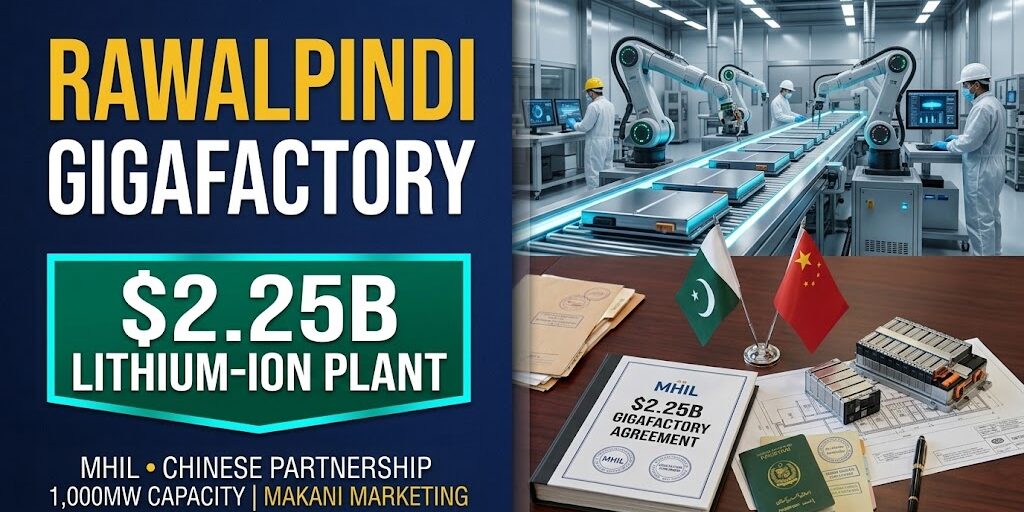
In what marks a watershed development for Pakistan’s clean energy storage and electric mobility ecosystem, Margalla Heavy Industries Limited (MHIL)—a defense-industrial enterprise operating under Heavy Industries Taxila (HIT) in the Rawalpindi district—has formalized a landmark $2.25 billion agreement with a Chinese consortium and local private investors to establish the country’s first large-scale Lithium-Ion Battery Gigafactory.
The initiative is engineered to address a projected domestic energy storage surge expected to cross 100,000 MW within the next four years, driven by rooftop solar adoption across residential and commercial sectors, industrial Battery Energy Storage Systems (BESS), and rapid electrification across 2-wheelers, 3-wheelers, passenger cars, and commercial bus fleets.
                [MHIL $2.25B Lithium-Ion Gigafactory Architecture]
                                         │
        ┌────────────────────────────────┼────────────────────────────────┐
        ▼                                ▼                                ▼
[Production Phasing]            [National Expansion Blueprint]   [Supply Chain Localization]
• Groundwork at HIT Rawalpindi  • 4 Gigafactories Planned:        • Shift from assembly to 100%
• Initial run: 200–300 MW        - Rawalpindi (Hub facility)        local cell manufacturing
• Scalable to 1,000+ MW/year     - Lahore, Faisalabad & Karachi   • Domestic motors, chargers
• Production in 6–8 months       • Caters to 100,000 MW demand      and controllers integrated
1. Technical Phasing & Production Timeline
- Initial Operational Capacity: The Rawalpindi gigafactory will commence commercial operations within six to eight months of final national regulatory policy approval, starting with an initial manufacturing capacity of 200 to 300 megawatts (MW).
- Annual Scale-Up: Production lines are engineered to scale progressively beyond 1,000 MW annually, shifting Pakistan from an importer of knocked-down battery packs into a primary manufacturer of certified lithium-ion cells.
- Industrial Footprint: Operating from the defense-industrial manufacturing zone of Taxila/Rawalpindi, the plant leverages established precision-engineering infrastructure, dedicated heavy-haul road networks, and secure industrial grid connections.
2. Strategic Macroeconomic & Energy Independence Dividends
- Curving Import Outflows: Pakistan currently spends billions of dollars on imported fossil fuels and completely built-up energy storage equipment. Establishing an indigenous lithium cell line insulates foreign exchange reserves from volatile supply shocks.
- Accelerating EV & Renewable Adoption: As net-metering structures evolve and solar adoption expands, local battery energy storage systems (BESS) provide grid stability and commercial backup, enabling industrial units to store daytime solar output for peak evening operations.
- Paving the Way for Industrial Corridors: The project serves as the anchor for a broader four-factory national deployment plan spanning Rawalpindi, Lahore, Faisalabad, and Karachi, positioning Pakistan as a future regional exporter of battery cells to Central and South Asian markets.
3. Real Estate & Regional Industrial Impact: The Rawalpindi-Taxila Axis
From an industrial real estate and commercial property standpoint, the capital injection of $2.25 billion into the Rawalpindi district generates significant economic tailwinds:
- Industrial Land & Warehousing Appreciation: Strategic land along the Taxila, GT Road, and CPEC Western Route (M-4/M-1 interchange) corridors will see heightened demand for specialized logistics warehouses, lithium raw material handling hubs, and component manufacturing facilities.
- Corporate & Residential Influx: Large-scale gigafactories draw hundreds of specialized Chinese technical engineers, industrial consultants, and allied suppliers into the Rawalpindi-Islamabad region, bolstering high-end rental yields and serviced corporate accommodation in surrounding CDA sectors and expressway communities.
- Infrastructure Upgrades: Heavy power and transit requirements for the gigafactory will accelerate municipal grid investments, industrial water supply projects, and regional road widening across the northern Rawalpindi industrial belt