
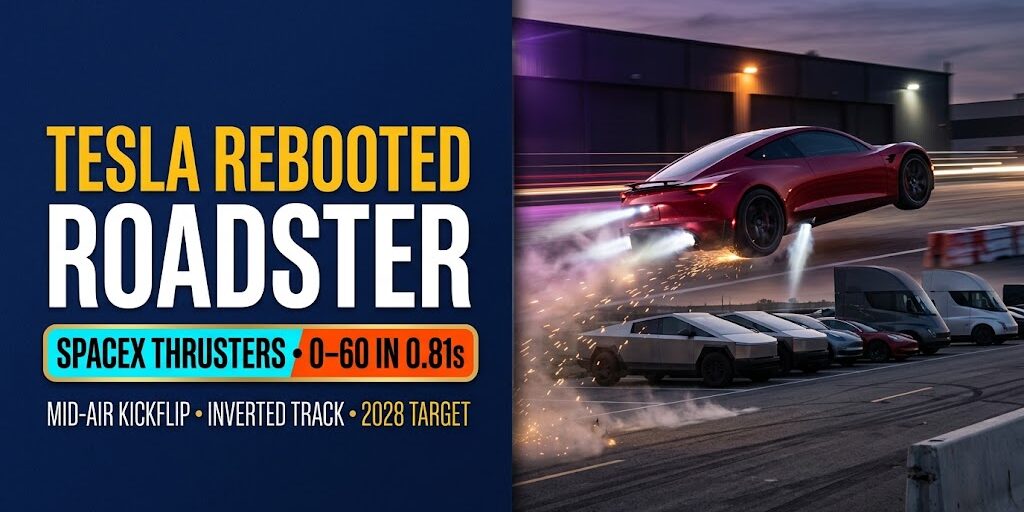
In what stands as one of the most unconventional live demonstrations in modern automotive history, Tesla officially took the wraps off its completely re-engineered, rebooted next-generation Roadster at SpaceX’s rocket development facility in McGregor, Texas.
Moving past traditional sports car parameters, Tesla presented a vehicle developed at the convergence of pure electric propulsion and aerospace rocket dynamics. Featuring ultra-high-pressure cold-gas rocket thrusters integrated with an active underbody ground-effect vacuum system, the Roadster demonstrated feats previously confined to flight simulators and sci-fi cinema: sprinting from 0 to 60 mph in 0.81 seconds, driving fully inverted on an overhead track, and performing a mid-air leap and “kickflip” over Tesla’s entire vehicle fleet.
Next-Gen Tesla Roadster Key Metrics
| Performance & Engineering Metric | Demonstration / Target Specification |
| 0 to 60 mph Acceleration | 0.81 Seconds (On-track verified with thruster assist) |
| Aerospace Thruster System | SpaceX cold-gas thrusters (Composite Overwrapped Pressure Vessels – COPV) |
| Total Thrust Output | Generates upwards of 80 kN of pneumatic thrust |
| Aerodynamic Inversion | High-downforce vacuum suction allowing inverted roof-track driving |
| Mid-Air Capability | Pneumatic jump and single-axis roll clearance over Cybertruck, Semi & Model lineup |
| Top Speed Envelope | Baseline >230 mph; target aerodynamic ceiling approaching Mach 0.5 |
| Planned Production Window | Targeted for 2028 assembly at Giga Texas |
| Regulatory & Street Legality | Standard EV mode road-legal; thruster flight mode restricted by jurisdiction |
1. Demolishing the Physics Barrier: 0 to 60 mph in 0.81 Seconds
Standard production hypercars face a fundamental physical limit known as the friction coefficient limit of pneumatic rubber on tarmac. Even with bespoke sticky slicks, all-wheel drive, and dual/tri-motor electric torque, chemical rubber grip struggles to break below 1.6 to 1.8 seconds for 0–60 mph under standard gravity ($1g$).
[Standard Electric Hypercar] ──► Traction limited by tire-to-tarmac chemical grip (~1.6s limit)
                                                │
                                                ▼
[Roadster + SpaceX Package]   ──► Ground-Effect Suction + Downward & Backward Thrusters
                                  • Simulates multi-g downforce at 0 mph
                                  • Adds 80+ kN of direct horizontal pneumatic thrust
                                  • Result: 0 to 60 mph in 0.81 Seconds
To achieve 0.81 seconds, the Roadster does not rely on tire grip alone:
- Underbody Vacuum Ground Effect: High-speed suction fans seal the vehicle skirts against the tarmac, generating multiple tonnes of artificial downforce at a standstill.
- COPV Air Thrusters: Replacing the rear passenger seats, SpaceX-developed Composite Overwrapped Pressure Vessels (COPV) store compressed air at roughly 10,000 PSI, releasing directed cold-gas pulses out of concealed body nozzles to accelerate the chassis forward like a launchpad projectile.
2. The Mid-Air “Kickflip” & Vehicle Leap
The centerpiece of the Texas showcase occurred when the vehicle approached an obstacle line featuring Tesla’s full production lineup—including the Model 3, Model Y, Cybertruck, Cybercab, and the Tesla Semi.
Rather than braking or maneuvering around them:
- The vehicle engaged downward-facing high-pressure cold-gas impulse nozzles, launching the car clean off the tarmac.
- Actuating differential side nozzles mid-flight induced an axial roll—dubbed by Tesla engineering leadership as an automotive “kickflip”—before leveling out and landing on its active suspension on the runway.
- While presented as an extreme capability showcase, the underlying engineering demonstrates reaction-control systems (RCS) applied to automotive emergency avoidance, obstacle clearing, and active chassis stabilization.
3. Inverted Overhead Track Driving
Building upon ground-effect aerodynamics pioneered in Formula 1 and fan-car engineering, the demonstration included an inverted ramp run:
- Utilizing continuous high-volume electric vacuum turbines beneath the chassis, the car created a low-pressure zone between the undertray and a specialized overhead metal running track.
- By generating downforce far exceeding the vehicle’s curb weight, the Roadster was able to drive upside-down along an elevated section, demonstrating the sheer volume of negative pressure generated by its active ground-effect aero.
4. Production Horizon, Pricing & Regulatory Realities
While the engineering demonstration established what electric drivetrains combined with compressed-gas aerospace systems can achieve, practical commercialization involves key hurdles:
- Production Target: Tesla has slated customer assembly for 2028 at Giga Texas, giving engineering teams time to transition the prototype mechanisms into road-viable production hardware.
- Jurisdictional Legality: Compressed gas thrusters, mid-air leaps, and active vacuum skirts will face stringent transportation safety reviews (such as FMVSS in the US and UNECE in Europe). As noted during the reveal, the standard electric drive modes will be street-legal, while extreme thruster-assisted modes will likely be restricted to track or proving-ground software geofences.
- Energy Management: The extreme air pressure required for thruster bursts requires heavy-duty on-board compressors that refill the COPV tanks between performance launches using power from the main structural high-voltage battery pack.
The New Frontier of Automotive Performance
Whether viewed as an audacious technical stunt or the dawn of aerospace-integrated electric supercars, the rebooted Tesla Roadster pushes the boundaries of personal transport. By merging electric motor torque with rocket reaction thrusters, it challenges traditional conceptions of speed, traction, and vehicular control.