
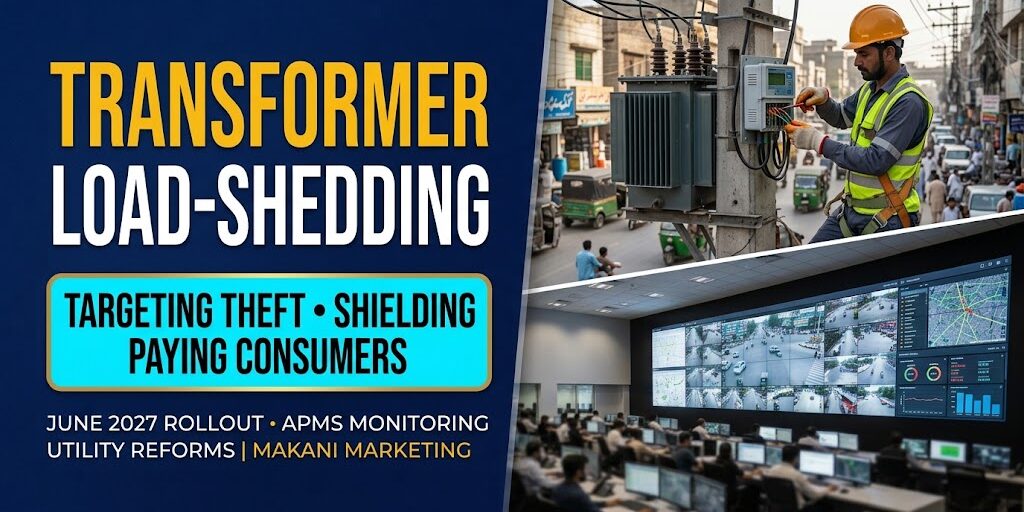
In a policy shift addressing unfair power distribution practices, the Ministry of Energy (Power Division) has announced that Pakistan will transition its scheduled load-shedding mechanism away from broad, high-loss electricity feeders down to individual distribution transformers starting in June 2027.
Federal Minister for Energy Sardar Awais Ahmad Khan Leghari confirmed the strategic initiative, underscoring that the current practice of subjecting entire 11kV feeders to collective blackouts penalizes honest, bill-paying households and commercial enterprises simply because non-paying consumers or electricity thieves share the same distribution line.
By deploying Asset Performance Management Systems (APMS) and advanced digital metering modules across the national distribution network, distribution companies (DISCOs) will be equipped to monitor power consumption and line losses at the local transformer level, confining disconnections strictly to defaulting or high-theft clusters.
At Makani Marketing, our commercial infrastructure and property advisory desk monitors national utility modernization. Uninterrupted power availability remains one of the primary drivers of commercial footfall, industrial productivity, and sustained real estate capital appreciation. Below is an operational breakdown of this policy shift, the supporting technology, and its broader economic implications.
Power Distribution Reform at a Glance
| Policy Parameter | Official Ministry of Energy Directive |
| Governing Authority | Ministry of Energy (Power Division) |
| Implementation Timeline | Commencing rollout in June 2027 |
| Core Structural Reform | Ending feeder-level collective outages; shifting to transformer-level management |
| Primary Beneficiaries | Honest, regular bill-paying consumers & commercial businesses |
| Enabling Technology | APMS (Asset Performance Management Systems) & digital telemetry |
| Current Baseline Rule | Feeders with Aggregate Technical & Commercial (AT&C) losses ≥30% face scheduled cuts |
| Operational Impact | Localized disconnections for power theft without disrupting compliant neighborhoods |
| Advisory & Infrastructure | Makani Marketing Corporate Advisory |
1. The Flaw in Feeder-Based Load Management
For over a decade, Pakistan’s power sector has managed high Aggregate Technical & Commercial (AT&C) losses through a blunt policy: feeder-category load-shedding.
[Traditional System: 11kV Feeder Serving 1,500+ Consumers]
                      │
   ┌──────────────────┴──────────────────┐
   ▼                                     ▼
[80% Paying Consumers]             [20% Power Theft / Defaulters]
   │                                     │
   └──────────────────┬──────────────────┘
                      │
                      ▼
[High AT&C Losses (≥30%) Triggers Complete Feeder Shutdown]
(Paying consumers forced into collective 4- to 8-hour outages)
Under this legacy framework, if an 11kV feeder serving 1,000 to 2,000 consumers registers technical and theft losses exceeding 30%, the entire line is subjected to scheduled rolling blackouts ranging from 4 to 8 hours daily. This approach created significant problems:
- Injustice to Compliant Users: Residents and shop owners who clear monthly utility bills on time endure identical power outages as chronic defaulters.
- Disincentive to Pay: When paying consumers experience persistent power cuts regardless of their payment discipline, compliance drops, encouraging informal bypasses (kunda connections).
- Commercial Productivity Drain: Urban retail markets and small enterprises on mixed feeders are forced to run expensive secondary diesel/petrol generators, driving up operational overheads.
2. How Transformer-Level Isolation Works
The transition to localized transformer-level management relies on the nationwide rollout of Asset Performance Management Systems (APMS):
[Substation Supplies 11kV Feeder Line Uninterrupted]
                         │
                         ▼
[Distribution Transformers Fitted with Digital APMS Units]
                         │
        ┌────────────────┴────────────────┐
        ▼                                 ▼
[Transformer A (0–5% Line Loss)]   [Transformer B (High Theft / Loss)]
• Fully compliant street           • Illegal hookups & non-payment
• Uninterrupted 24/7 power         • Remote shutoff / targeted load-shedding
- Granular Loss Detection: APMS units measure incoming high-voltage electricity and cross-reference it against downstream consumer meter readings in real time, pinpointing the exact transformer where line loss occurs.
- Automated Remote Interventions: Rather than switching off the entire substation circuit breaker, DISCO command centers can remotely isolate, throttle, or disconnect the specific overloaded or high-theft transformer without impacting neighboring streets.
- Hardware Protection: Localized monitoring protects distribution transformers from catastrophic burnouts caused by unmetered, illicit heavy loads during peak summer heatwaves.
3. Financial & Grid Benefits: Reducing the Circular Debt Burden
Targeting electricity theft at the transformer level addresses the root cause of the country’s circular debt:
- Incentivizing Community-Level Compliance: When non-paying users realize their illegal connections affect only their immediate block rather than penalizing the broader neighborhood, community peer pressure to eliminate kunda connections increases.
- Lower Capacity Payment Penalties: Keeping compliant consumers energized allows DISCOs to sell more baseline power, offsetting idle capacity payments owed to Independent Power Producers (IPPs) and helping stabilize national power tariffs.
- Data-Driven Anti-Theft Operations: Law enforcement and DISCO task forces can deploy field inspection teams directly to pinpointed transformer coordinates rather than conducting speculative neighborhood raids.
4. Real Estate & Commercial Asset Valuation
Access to dependable, unshared electrical infrastructure directly influences property valuation across Pakistan’s urban centers:
A. Commercial Plazas & High-Street Retail
- Commercial avenues that secure dedicated, zero-loss transformer connections or sit on modernized smart-grid infrastructure experience higher tenant retention. Lower generator fuel costs allow retailers to operate with better profit margins, supporting higher commercial rental yields.
B. Master-Planned Gated Communities
- Gated housing schemes that manage their own underground utility distribution networks with localized metering already command significant price premiums over unorganized suburban sprawl. As government DISCOs shift to transformer-level accountability, properties situated in organized sectors will see enhanced market demand.
C. Industrial Warehousing & Light Manufacturing
- Logistics centers, cold-storage facilities, and light industrial units depend heavily on predictable power. Removing collective feeder blackouts ensures uninterrupted production cycles, increasing the value of industrial land along major transit corridors.
Capitalize on Infrastructure-Led Real Estate with Makani Marketing
As Pakistan modernizes its arterial highways, urban surveillance networks, and utility distribution grids, commercial and residential land values are recalibrating around infrastructure reliability. Investing in developments with verified utility access safeguards long-term capital.
At Makani Marketing, our real estate development and investment advisory desk assists clients by:
- Sourcing verified commercial properties, residential plots, and corporate offices in master-planned schemes with dedicated utility infrastructure.
- Assessing municipal utility approvals, underground electrical layouts, and society NOCs across the Twin Cities and Punjab.
- Guiding investors on commercial land acquisitions positioned for high rental yields and capital growth.
- Ensuring transparent, legally verified property transfers with complete documentation.
Contact Makani Marketing today to explore verified real estate investment opportunities across Pakistan’s fastest-growing urban corridors.