
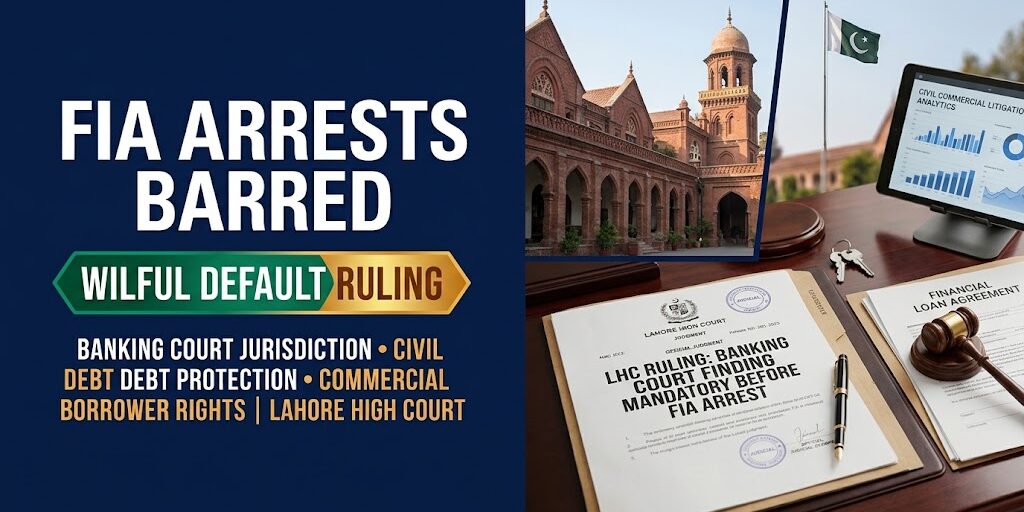
In a landmark judgment delivering significant legal relief to commercial borrowers, corporate entrepreneurs, and bank customers across Pakistan, the Lahore High Court (LHC) has officially barred the Federal Investigation Agency (FIA) from initiating criminal inquiries, registering First Information Reports (FIRs), or arresting bank customers over alleged loan defaults until a competent Banking Court has formally determined civil liability and established “wilful default.”
The ruling addresses a widespread legal gray area wherein financial institutions frequently utilized the FIA’s anti-corruption and commercial crime wings as a debt-recovery tool, bypassing civil adjudication processes under the Financial Institutions (Recovery of Finances) Ordinance. The LHC established that commercial loan disputes are fundamentally civil matters that cannot be converted into criminal proceedings without prior judicial substantiation of fraud or intentional evasion.
                 [Lahore High Court FIA vs. Banking Court Jurisdictional Framework]
                                                   │
        ┌──────────────────────────────────────────┼──────────────────────────────────────────┐
        ▼                                          ▼                                          ▼
[The Core Legal Prohibition]              [The Mandatory Prerequisite]               [The Civil vs. Criminal Boundary]
• FIA barred from arresting borrowers      • Banking Court must first adjudicate      • Financial default is civil in nature
• No criminal FIRs for simple defaults      • Formal finding of "Wilful Default" required • Criminal fraud requires proven intent
• Eliminates debt recovery via police       • Statutory recovery procedures prioritized • Protects legitimate business operations
1. The Core Legal Principle: Separating Civil Debt from Criminal Fraud
The Lahore High Court emphasized that borrowing funds, experiencing business liquidity distress, or failing to meet commercial repayment schedules does not ipso facto constitute a criminal offense.
- The Presumption of Commercial Risk: Enterprise borrowing involves inherent business risk. A failure to service a debt is a civil breach of contract, not a criminal act of cheating or fraud.
- Prohibiting Coercive Debt Collection: The judgment explicitly restrains law enforcement agencies from acting as recovery agents for commercial banks, protecting citizens from arbitrary harassment, intimidation, and unlawful detention.
- Exclusive Jurisdiction of Banking Courts: Under statutory law, the recovery of bank finance and the determination of default lie exclusively within the jurisdiction of specialized Banking Courts, not investigative police agencies.
2. The Mandatory Two-Step Process Before FIA Intervention
Under the LHC’s binding directives, law enforcement agencies must follow a strict procedural sequence before taking any cognizance of financial defaults:
                 [The Mandatory Legal Sequence for Loan Default Investigations]
                                               │
                                               ▼
                [Commercial Loan Default Occurs / Payment Delinquency]
                                               │
                                               ▼
                [Bank Initiates Civil Recovery Suit in Specialized Banking Court]
                                               │
                                               ▼
                [Banking Court Adjudicates Matter & Formally Declares "Wilful Default"]
                                               │
        ┌──────────────────────────────────────┴──────────────────────────────────────┐
        ▼                                                                             ▼
[Path A: Standard Civil Default]                                              [Path B: Proven Wilful Fraud / Mala Fide]
• Banking Court issues decree for asset recovery                              • Banking Court officially determines criminal fraud
• Execution proceedings handled via civil bailiffs                            • Certified finding transmitted to investigative agencies
• No FIA jurisdiction, no criminal arrest, no FIR                             • FIA permitted to initiate criminal proceedings
3. Implications for Pakistan’s Business and Banking Sectors
The LHC ruling provides essential structural safeguards for the commercial economy:
- Restoring Investor Confidence: Entrepreneurs and SME owners can engage with commercial banking credit lines without fearing arbitrary criminal arrest during economic downturns.
- Reforming Bank Recovery Practices: Commercial lenders are now required to pursue legal remedies through civil recovery suits and asset attachments rather than leveraging pressure through criminal investigative bodies.