
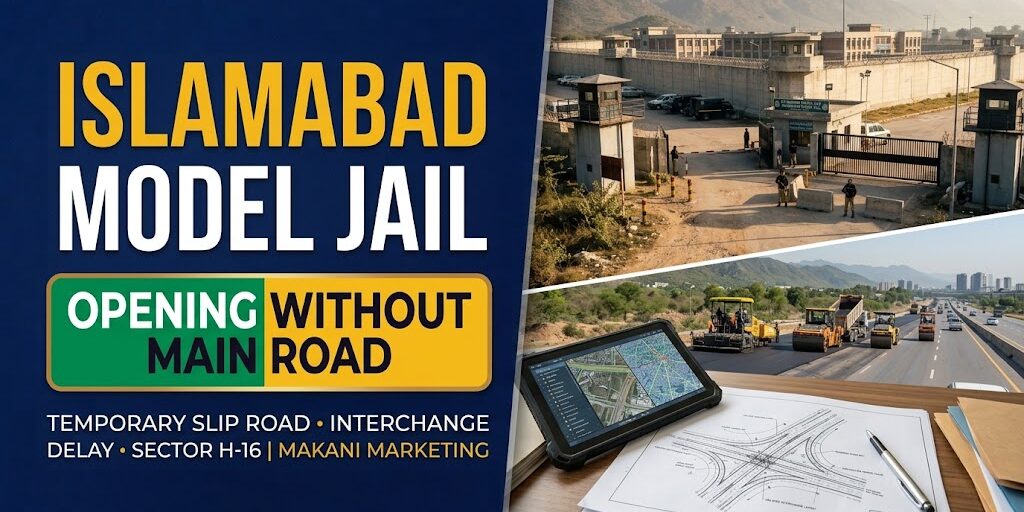
In an infrastructure dilemma for the federal capital, Phase 1 of the Rs. 7 billion Islamabad Model Jail Complex in Sector H-16 has reached completion and is prepared for administrative commissioning, yet lacks its approved permanent signal-free access link.
Despite master-plan approvals designating a dedicated multi-loop interchange connecting Sectors H-16, H-17, G-16, and G-17 directly to Srinagar (Kashmir) Highway, construction on the permanent junction has not materialized. Facing immediate operational deadlines to ease severe overcrowding at Rawalpindi’s Adiala Jail, authorities—led by directives from the Prime Minister’s Inspection Commission—have requested the National Highway Authority (NHA) and Capital Development Authority (CDA) to arrange a temporary slip road to facilitate secure prisoner transit and police convoys.
At Makani Marketing, our real estate and urban development desk monitors municipal planning milestones, arterial access routes, and civic utility execution. Road connectivity remains the primary catalyst for property value in Islamabad’s expanding sectors. Below is a breakdown of the access arrangements, security considerations, and what the delay means for neighboring property developments.
Islamabad Model Jail Access Dilemma at a Glance
| Project Parameter | Official Case Specification |
| Project Name | Islamabad Model Jail / Prison Complex |
| Geographic Location | Sector H-16, Islamabad (South of Srinagar Highway) |
| Total Approved Outlay | Approx. Rs. 7 Billion (Phased Public Sector Development) |
| Current Project Status | Phase 1 complete (Barracks, medical center & admin blocks) |
| Missing Infrastructure | Approved permanent Model Prison Interchange on Srinagar Highway |
| Interim Solution | Temporary paved slip road requested from NHA for vehicle transit |
| Operational Impact | Single-lane bottleneck for prison vans, court escorts, and supplies |
| Surrounding Sectors | H-16, I-16, G-16, G-17, and Thalian Motorway links |
| Advisory & Infrastructure | Makani Marketing Corporate Advisory |
1. Phase 1 Delivery vs. The Missing Interchange
The Islamabad Model Jail was conceptualized to resolve a longstanding jurisdiction issue: Islamabad Capital Territory (ICT) previously lacked its own central penitentiary, forcing courts to send thousands of detainees to Central Jail Rawalpindi (Adiala Jail), which routinely operates at two to three times its design capacity.
[Phase 1 Jail Infrastructure Completed in Sector H-16]
                         │
                         ▼
[Approved Plan: Signal-Free Interchange on Srinagar Highway (Kashmir Highway)]
                         │
        ┌────────────────┴────────────────┐
        ▼                                 ▼
[The Ground Reality]              [The Interim Solution]
• Permanent interchange unbuilt   • PM Inspection Commission steps in
• No grade-separated direct turn  • NHA asked to build temporary slip road
• Potential traffic chokepoints   • Paved access for prisoner vans & escorts
While the internal institutional buildings—including three inmate barracks, security watchtowers, a specialized hospital, biometric record centers, and on-site ICT courtrooms—are structurally ready, the arterial transport access was decoupled from civil construction timelines.
The original CDA master plan designated an interchange connecting the H-16/H-17 sector dividing road directly across Srinagar Highway to G-16/G-17. Without this interchange, high-speed traffic moving between Islamabad city center and the M-1/M-2 motorway toll plazas cannot safely turn directly into Sector H-16.
2. High-Risk Security Concerns with Temporary Access
Relying on a temporary slip road introduces notable logistical and security challenges:
- Prisoner Transit Vulnerabilities: Convoy routes transporting high-profile detainees between the Islamabad High Court (IHC), District Courts, and Sector H-16 require uninterrupted movement. Narrow slip roads or sharp turns off a 100 km/h expressway create potential ambush and accident risks.
- Heavy Vehicle Traffic Conflicts: Daily movement of supply trucks, food rations, police personnel buses, and visitor shuttles maneuvering through an improvised detour can disrupt the fast-moving outer lane of Srinagar Highway.
- Emergency Clearance: In the event of an inmate medical emergency requiring transfer to PIMS or the Federal Government Polyclinic, emergency ambulances face slower merge times onto the main highway corridor.
3. Urban Planning Impact: The Ripple Effect on Western Islamabad
The missing interchange highlights a recurring coordination gap between civic authorities (CDA), highway planners (NHA), and administrative departments:
- Inter-Agency Delays: While CDA develops internal sector land, structural links onto federal highways require NHA funding clearances and joint design alignments.
- Zone 1 & 2 Development Lag: The southern industrial and institutional sectors (H-15, H-16, I-15, I-16) have historically experienced slower infrastructure deployment compared to the northern residential sectors (F and G series).
- The Necessity of the Full Interchange: The planned junction at H-16/G-16 is not just a prison gate; it is designed as a primary urban interchange connecting the residential populations of G-16 (Ministry of Interior / Jammu & Kashmir housing schemes) and G-17 directly with the industrial and logistics belt of H-16 and I-16. Constructing the complete interchange remains critical for long-term traffic flow.
4. Real Estate Analysis: Sector H-16 & Surrounding Belts
Infrastructure delays often create short-term friction while revealing long-term investment patterns for property investors:
A. Sector H-16 & I-16 Industrial/Commercial Value
- Sector H-16 is designated largely for institutional, healthcare, and educational development, while adjacent Sector I-16 serves as an affordable residential and commercial hub. The urgent federal pressure to operationalize the jail is accelerating road paving, utility installation (water, electricity grids, gas mains), and security patrols across the entire sector pocket.
B. The G-16 & G-17 Commercial Nodes
- Housing societies on the northern side of Srinagar Highway (including G-16 and G-17) stand to benefit once the federal government formally tenders and builds the full permanent interchange. Grade-separated access across the highway will eliminate detour distances to the M-2 motorway and Islamabad International Airport.
C. Buyer Due Diligence on Arterial Links
- This scenario highlights an important principle in real estate acquisition: always verify ground-executed access roads versus paper master-plan promises. Investing in sectors with operational, signal-free expressway connectivity yields faster capital growth than waiting on pending interchanges.
Navigate Twin Cities Infrastructure & Real Estate with Makani Marketing
Strategic property investing requires tracking the ground reality of municipal approvals, road networks, and government developments. Knowing when and where primary interchanges and bypasses will be constructed allows investors to purchase assets before transit connectivity drives prices upward.
At Makani Marketing, our commercial and residential advisory desk provides:
- Comprehensive infrastructure auditing across CDA sectors, RDA housing schemes, and CPEC-linked transit belts.
- Layout plan (LOP) and arterial road connectivity assessments for sectors in Zone 1, Zone 2, and the Motorway link corridor.
- Verified property sourcing for commercial plots, residential homes, and logistics land across the Twin Cities.
- Transparent, legal property transfers backed by full revenue and municipal authority documentation.
Contact Makani Marketing today to explore prime commercial and residential real estate investment opportunities across Islamabad and Rawalpindi.